Summary of this article
May in Miyako Island is a comfortable time to dive, with water temperatures around 25℃, and it's a month of early summer when the crowds tend to subside after Golden Week. Diving records from 2022 to 2025 show that 66% of dives were to Shimoji Island, 29% to Irabu Island, and 5% to Yaebise.
Popular diving spots on Shimojishima Island, such as Antonio Gaudí, the Demon King's Palace, and Mini Toriike Pond, are easily accessible. However, on days when southerly winds increase, we sometimes head towards Irabu Island. Even during the rainy season, wind direction has a greater impact on point selection than the rain itself.
This article organizes and compares water temperature, clothing recommendations, weather data, frequently visited dive sites, and important points to consider before booking, month by month. Whether you're diving in Miyako Island for the first time or returning specifically to explore its unique topography, this information will be helpful in deciding when to travel.
Last updated: 2026-05-17
Why May is the perfect month to visit the beach in early summer after Golden Week.
If I had to describe Miyako Island in December in one word,As the water temperature rises, the crowds subside after Golden Week, making it a hidden gem in early summer..
The water temperature remains a little chilly until April, but by May it rises to around 25°C, making diving much easier. The boat is also not as cold as in winter, so sun protection becomes more important than keeping warm after diving.
Based on BIGHOLIDAY's data from the past four years (2022-2025), May saw 66% of trips to Shimojishima, 29% to Irabujima, and 5% to Yaebise. May is a month where you can easily combine trips to Irabujima with trips focusing on the topographical points of Shimojishima.
May is also the start of the rainy season. However, the rainy season in Miyako Island is different from the long rains on the mainland; it rains heavily for a short time, and then there are often sunny spells. What's important for diving is not the rain itself, but the wind direction, waves, and swells.
While it tends to get crowded during Golden Week, things calm down considerably afterward. The water temperature rises, there are more ocean options, and the crowds decrease. May is a very good month to go diving if you choose your timing right.
Data reveals the trends in diving in Miyako Island in February.
The table below shows diving records from 2022 to 2025, organized by month. By looking at the area distribution and the frequency of frequently occurring points, it becomes easier to see which sea areas are more suitable for diving in February.
Area trends in February
| Area | Proportion | How to read |
|---|---|---|
| Toward Shimojishima | 66 % | The central area aims to capture the unique topography of Miyako Island. |
| Towards Irabu Island | 29 % | Easy to combine depending on sea conditions and shop policies |
| Towards Yaebiji | 5% | It becomes a candidate on days with calm sea conditions. |
Points that frequently appear in February
| Key Points | Occurrence rate relative to the number of diving days | Guidelines for aiming |
|---|---|---|
| Antonio Gaudi | 22.6 % | If the sea conditions are favorable, it's likely to become a top priority candidate. |
| Maou no Kyuden | 21.5 % | If the sea conditions are favorable, it's likely to become a top priority candidate. |
| Mini Toriike | 19.4 % | It is easy to enter as a topographical candidate for the Shimojishima area. |
| Marine Lake | 18.3 % | It is easy to enter as a topographical candidate for the Shimojishima area. |
| 35 hole | 17.2 % | It is easy to enter as a topographical candidate for the Shimojishima area. |
These numbers do not mean that we are guaranteed to go. The actual selection of a dive site will be decided on the day, taking into account wind direction, waves, swell, tides, and the team's skill level. When planning your trip, it's best to allocate 2-3 days for diving if there are specific dive sites you want to visit, as this will increase your chances of success.
Points to target in February

From here on, we'll discuss how to choose a dive site based on the sea conditions, visibility, and difficulty level in January. The best choice isn't always the same as the most frequently dived spots; the best choice will depend on the wind, waves, the guests' diving experience, and the overall skill level of the team on that particular day.
Antonio Gaudi

This is a representative dive site with a unique topography, located near Shimoji Island, where I often go diving in December.
The complex, overlapping arch structure becomes more three-dimensional when the water is still somewhat clear. May is a good time to enjoy diving in deeper areas with unique topography, as the water temperature rises and it becomes easier to move around.
This spot is deep and challenging, so you need to make a judgment based on your experience and skill level. If you're aiming to see Antonio Gaudí, it's recommended to create an opportunity by making it a 2-3 day trip rather than focusing on just one day.
Maou no Kyuden

This is a representative geological spot in Miyako Island that you'll want to target in May as well.
May is the time when the sun rises higher in the sky, and the light from topographical features becomes stronger. At the Demon King's Palace, the contrast between light and blue becomes more pronounced, allowing you to enjoy a brighter landscape appearance that is different from winter.
However, the weather can be unpredictable around the start of the rainy season. Sunny days are important if you're aiming for bright sunlight, but this spot can also be enjoyed for its clear waters and the impressive topography itself.
Mini Toriike

This is a cave/hole-type dive site near Shimoji Island that I often go diving at in March.
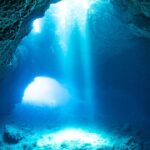
As the water temperature rises in May, it becomes easier to calmly enjoy the tranquility inside the cave and its unique structure that allows you to surface. The blue of the cave's interior and the sense of openness at the exit are also beautifully apparent when the sea conditions are right.
While not as challenging as the original Toriike Pond, neutral buoyancy and ear equalization are important as it is a cave-like point. We will tailor the plan to suit the team on the day, ensuring everyone can enjoy it without overexerting themselves.
Weather Data
May marks the beginning of early summer in Miyako Island. The table below shows the average values (1991-2020) from the Japan Meteorological Agency and the Miyako Island Local Meteorological Observatory, along with recommended water temperatures for diving, broken down by month. This allows you to compare how much the air temperature, water temperature, and sunshine hours vary throughout the year, rather than just looking at May alone. More sunshine hours indicate more sunny days, while less sunshine indicates more cloudy days.
| Month | Average temperature | Water temperature guide | 降水量 | sunshine time |
|---|---|---|---|---|
| April | 18.3 ℃ | Around 22 ℃ | 131 mm | 83 hours |
| April | 18.6 ℃ | Around 21 ℃ | 120 mm | 86 hours |
| April | 20.1 ℃ | Around 22 ℃ | 131 mm | 111 hours |
| April | 22.8 ℃ | Around 23 ℃ | 150 mm | 131 hours |
| April | 25.0 ℃ | Around 25 ℃ | 207 mm | 148 hours |
| April | 27.7 ℃ | Around 27 ℃ | 210 mm | 179 hours |
| April | 28.9 ℃ | Around 29 ℃ | 141 mm | 243 hours |
| April | 28.6 ℃ | Around 29 ℃ | 234 mm | 218 hours |
| April | 27.6 ℃ | Around 29 ℃ | 254 mm | 189 hours |
| April | 25.5 ℃ | Around 27 ℃ | 189 mm | 162 hours |
| April | 23.1 ℃ | Around 25 ℃ | 148 mm | 118 hours |
| April | 20.0 ℃ | Around 23 ℃ | 131 mm | 93 hours |
May brings rising average temperatures and water temperatures, making it quite comfortable. On the other hand, rainfall increases around the start of the rainy season. However, it's the wind and waves, rather than the rain itself, that determine whether or not diving is possible.
Water temperature, wetsuits, and onboard equipment.
The water temperature in May is around 25℃. You can lighten your winter gear considerably, making it a comfortable time for diving.
| Condition | Recommended equipment |
|---|---|
| M | 5mm wet |
| People who get cold easily | 5mm wetsuit + hooded vest |
| For those who are sensitive to heat in the latter half of the month | 3mm is also an option. |
| On board | Rash guards and sun protection |
| land | Short-sleeved shirt, shorts, and sandals |
May is a popular time for diving, with many people comfortably using 5mm wetsuits. For those who get cold easily or are doing three dives, a hooded vest will provide extra comfort.
Onboard, sun protection is more important than keeping warm. Since UV rays are strong, it's a good idea to bring a rash guard, hat, and sunscreen.
Guide to Transparency
May is a time when the clarity of spring lingers while the sea gradually transforms into that of early summer. Even around the start of the rainy season, the rain itself doesn't necessarily significantly reduce the overall visibility of the water.
| Item | Indication |
|---|---|
| Transparency | 20-30m |
| Annual Trends | Average to high |
| Good shooting | Topography, light, organisms, wide |
May brings rising water temperatures and increased marine life activity. It's a great month to enjoy not only the underwater topography but also migratory fish.
Marine Life Calendar
In May, as water temperatures rise, marine life becomes more active. It's a great month to enjoy the underwater topography while also making it easier to spot marine life and migratory fish.
| Biology | Key Points | Encounter tendency |
|---|---|---|
| Giant trevally | Around the main drop | Medium to high |
| Bigeye trevally | Irabu Island, point near the open ocean | 中 |
| Nakanoshima Channel 333 | high | |
| Coral spawning | Around Shimoji Island and Irabu Island | If the timing is right |
May is not the prime time for manta ray fishing. The winter manta ray season is over, so in May it's best to focus on the early summer topography, marine life, and migratory fish.
Characteristics of the sea conditions
May is the month when southerly winds begin to stabilize. BIGHOLIDAY's data from 2022 to 2025 shows that in May, 66% of trips were to Shimojishima, 29% to Irabujima, and 5% to Yaebise.
On the Shimojishima side, topographic points such as Antonio Gaudi, the Demon King's Palace, Mini Toriike Pond, and Nakanoshima Channel are good options. On the Irabujima side, arch and drop-off type points are easier to combine.
In May, the water temperature rises, making it much more comfortable on the boat. However, the weather can change easily before and after the rainy season, and the available diving spots will vary depending on the wind direction and swell.
Points to consider when choosing a shop
March is a month when differences in point programs offered by different shops tend to become more apparent.
With options including Shimojishima, Irabujima, and Yaebise, the experience can vary considerably even within May, depending on which area you choose, when you target the open ocean, and what level of guest experience you cater to.
Some shops focus on exploring the terrain, while others prioritize stable, reliable spots. When choosing a shop in May, it's recommended to check if they can handle multiple areas in early summer and if they can select spots that match the guest's experience level.
Typhoon risk
The risk of typhoons in May is relatively low, but not zero. In recent years, there have been years where typhoons have had an impact at the end of May.
| Years | Number of approaches | Number of days affected |
|---|---|---|
| 2023 | 1 | About 7 days |
| 2024 | 0 | 0 |
| 2025 | 0 | 0 |
May is before the peak typhoon season, but some years typhoons can occur early. It's reassuring to be prepared, including having travel insurance.
Risk of departure cancellation
May generally brings stable sea conditions, making the risk of cancellations relatively low. However, cancellations may occur in the event of typhoons or strong winds.
| Risk of departure cancellation | Estimated number of days of suspension | Major cause |
|---|---|---|
| low | 1-2 days per month | Typhoon/Strong Wind |
Even after the rainy season begins, it's not often that we have to stop sailing just because it's raining. Wind and waves are the most important factors for diving. If the wind is light, we can sometimes dive even on rainy days.
If you're planning to visit popular dive sites or multiple areas in May, it's more practical to allocate 2-3 diving days rather than trying to do it all in just one day.
Crowding level and ease of making reservations
In May, the level of crowding changes significantly between the Golden Week period and the period immediately following it.
| Item | Indication |
|---|---|
| Congestion level | It tends to be crowded during Golden Week, and less crowded after Golden Week. |
| Peak within the month | GW |
| Target | From after Golden Week to late May |
Bookings tend to be concentrated during the Golden Week period. On the other hand, things calm down considerably after Golden Week, making it easier to enjoy diving in smaller groups at a more relaxed pace. If you can shift your vacation to May, the period after Golden Week is definitely a good time to go.
Airline ticket seasonality
May is a month where airfare prices tend to fluctuate significantly before and after Golden Week. After Golden Week, airfares and accommodations tend to become more stable.
| Item | Indication |
|---|---|
| JAL/ANA | Prices are high during Golden Week, but normal after Golden Week. |
| Periods when prices tend to be high | GW |
| Target | From after Golden Week to late May |
If you can take time off after Golden Week, the beach is pleasantly summery, and airfares tend to be less crowded. For those who want to minimize costs and crowds, mid-to-late May is a good time to aim for.
Supplementary information from the guide's perspective
In May, the water temperature in Miyako Island rises, making it much easier to dive.
After Golden Week, the crowds subside, making it easier to relax on the boats and at the dive sites. With water temperatures around 25℃, it's a good time to move around, and it's easier to plan dive sites around Shimoji Island and arches and drop-offs around Irabu Island.
The phrase "around the start of the rainy season" might sound worrying, but when it comes to diving, wind is more important than rain. If the wind is light, the sea can be calm even on rainy days.
FAQ
Q1. Is it possible to go diving in Miyako Island in May, even though it's the rainy season?
Yes, you can. The rainy season in Miyako Island isn't always a constant drizzle like on the mainland; sometimes it rains heavily for short periods, followed by sunny spells. For diving, wind and waves are more important than the rain itself.
Q2. What wetsuit thickness is suitable for diving in May?
The water temperature is around 25℃, so most people dive in 5mm wetsuits at this time of year. If you get cold easily or plan to do three dives, a hooded vest will give you peace of mind. Towards the end of the month, some people can even dive in 3mm wetsuits.
Q3. Can I visit the three major diving spots in Miyako Island in January?
If the sea conditions are favorable, you can aim for topographical points on Shimojishima Island, such as the Demon King's Palace, Antonio Gaudi, and Toriike Pond. In May, the proportion of dives on Shimojishima Island is high, and popular topographical points are among the top performers. However, the points you can go to will depend on the wind direction, swell, and the team's experience level.
Q4. Which is better to visit in May: during Golden Week or right after Golden Week?
If your purpose is diving, the period after Golden Week is a good time to aim for. While reservations and airfares tend to be expensive during Golden Week, the crowds subside afterward. The water temperature will have risen, and the sea conditions will not change significantly, so the period after Golden Week is recommended for those who can adjust their dates.
Q5. Are there typhoons in May?
While the risk is lower as it's before the peak typhoon season, it's not zero. In recent years, there have been years where typhoons in late May caused impacts. It's wise to be prepared, including travel insurance, just in case.
Articles you should read before making a reservation
Complete Guide to Diving in Miyako Island in April | A Hidden Gem Season for Stable Sea Conditions and Springtime Underwater Topography
Complete Guide to Diving in Miyako Island in June | Enjoy the South Wind and the Sea Towards Irabu Island in Early Summer
Miyako Island Fun Diving Complete Guide — How to Choose a Diving Spot, Season, and Shop
List of diving spots in Miyako Island
BIGHOLIDAY Fun Diving Rates

Totty — BIGHOLIDAY Owner's Guide
I've lived in Miyako Island for 21 years (since 2005). I specialize in fun diving. I select Miyako Island's three major dive sites more than 150 times a year, and I've done about 20,000 dives in Miyako Island. YouTube "Totty / scuba diving" shares Miyakojima diving information with more than twelve thousand subscribers.
Since 2023, we have been among the top-ranked Marine Diving Award winners for three consecutive years.
2023 Japan Coast Guard Director-General's Award (for meritorious service in maritime rescue)
Discoverer of Miyako Island's first manta ray station in 2025